Some Thoughts on "Solidarity: What Are We Fighting For? by Roger Berkowitz
This essay triggered me. In a good way.

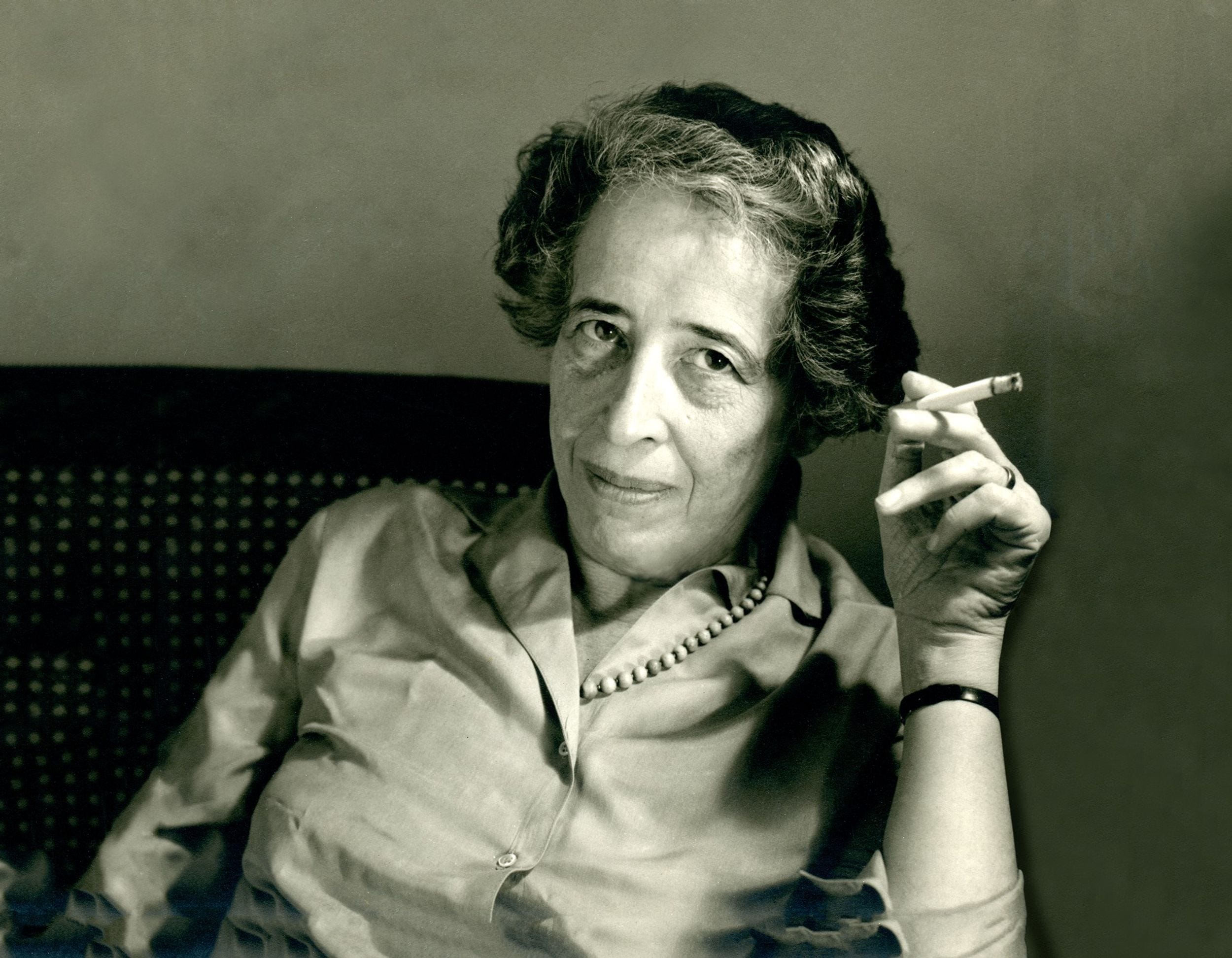
A brief preface: Just over 50 years ago, I received a note from the professor on my paper for a class titled “Contemporary Political Theory.” The paper was entitled “Hannah Arendt: Action, Power and Violence.” The professor, John S. Nelson of the University of Iowa, concluded his general remarks on the paper with this admonition: “Now concentrate on developing enough of your own political stance that you will be better able to fathom the implications of the kinds of criticisms you have pointed to in Arendt’s theory of politics.” I guess that comment struck me, because, upon writing the remarks below, I realize I’ve been continuing my quest to “develop my own political stance” and “become better able to fathom the implicaitons of the kinds of criticisms [that I] pointed to in Arendt’s theory of politics.” This is another iteration in that ongoing project. And now, perhaps more than ever in my life, this seems to me a worthwhile project. So at least I have a sense of what compels me to undertake these projects.
Roger Berkowitz, the founder and Director of the Hannah Arendt Center at Bard College, publishes a weekly essay on Medium and Substack about politics, most often, but not exclusively, viewed through an Arendtian lens. His essays are inevitably thoughtful and inspiring. But this one, published on May 3, “Some Thoughts on Solidarity: What Are We Fighting For?” is exceptionally noteworthy and worthwhile. And for me, it’s prompted some further thoughts, which I offer here.
Berkowitz opens with Arendt’s contention that the thread of tradition in the Western world has been destroyed:
Today, in the wake of the fact of totalitarianism, the pillars are shattered. “The break in our tradition,” Arendt writes, “is now an accomplished fact.”
. . . .
With the death of God, the collapse of inherited authority, and the dawning realization that anything is possible — that human beings can make, remake, and unmake worlds — politics has become terrifying, and we recoil from it. In doing so, however, we risk losing what makes life meaningful.
Arendt writes from her experience as a young Jewish woman in Nazi Germany, a refugee, and then an immigrant to the U.S. via a stay in France, a prison escape, and a journey on foot across the Pyrenees into Spain and eventually passage to the U.S. Add to this her deep and extensive knowledge of Western philosophy, political thought, and practice, and you understand how deeply she knows how broken the world has become. Thus, she writes how the pillars of tradition and authority have been “shattered.” But as human bones can be shattered and nearly destroyed by trauma, can we not heal the shattered pillars of tradition? Broken bones, even shattered bones, can sometimes be repaired sufficiently to restore function. Isn’t it possible that some part of the Western tradition can be salvaged and repaired sufficiently well to restore some of its function and value? Arendt, in my reading, can sometimes prove too sweeping in her generalizations, and this might be such an instance. Some Western traditions concerning politics, authority, thought, and religion survive and can be repaired and built upon. This tradition, as a whole, may no longer be dominant, but it can nevertheless provide a counter-cultural perspective to our current cultural and political disarray. The momentous changes wrought by modernity in the last 250 years (to pick a number that pops to mind), such as the Enlightenment, the development of our sciences, industrialization, mass production and consumption, mass media, industrial warfare, and more lethal and pervasive authoritarian and totalitarian political regimes, have certainly provided exceptionally daunting challenges to how we live, think, and engage in politics. One can’t deny this, but some of the changes brought about by modernity have led to immense improvements in human welfare, if not necessarily to our political discourse. Does anyone want to be treated by a physician from 250 years ago, to travel by horse and buggy, or do without vaccines? (Okay, perhaps I should strike that last phrase, but I don’t want to go that route.) Somehow we must repair our body politic by incorporating the worthwhile and salavagable remnants of our tradition while creating new cultural pillars, perhaps by using models from other cultures and traditions. Technology, the motor of the immense changes realized by modernity, isn’t an inherent evil, though it too often magnifies human evils and follies.
For Arendt, this refusal of action is born from what she calls “the ominous silence that still answers us whenever we dare to ask, not ‘What are we fighting against,’ but ‘What are we fighting for?’”
This query from Arendt really strikes me. In the last 10 years, I have had a very clear sense of what I’m fighting against: authoritarianism, fascism, illiberalism, violence, ignorance, and folly, which have led to a decline in the quality of life and the well-being of Americans and a decline of our nation’s stature and efficacy on the world stage. In short, Trump and MAGA.
But what am I fighting for? Now that’s a deeply challenging question. It’s not for any utopia. Utopia is nowhere and not to be found. Perhaps we’re seeking a eu-topia, a good place—not perfect—but good enough, better than before. Maybe, and probably only for a while. My political thought and aspirations are, like Berkowitz’s, greatly influenced by Arendt, but, like Berkowitz (in a much more modest effort), not exclusively so. The liberals (broadly speaking) of the early and mid-20th century, Weber, Niebuhr, Camus, Aron, and Berlin, along with Lewis Mumford, have greatly influenced me. These thinkers were tempered by the Long War of the 20th century (1914-1989); their visions are not rosy, but neither are they apocalyptic in despair. They sought a modicum of decency, order, and freedom to foster a good life. Mumford, in addition to his strong political stance against fascism and totalitarianism, devoted much of his writing to attempts to better define a good life and what such a world might look like. Among the living, William Ophuls (still publishing at age 92!) has provided me with the most comprehensive assessment and critique of our current dilemma, along with suggestions as to how a world of tomorrow might function to create a decent life (although he warns the road to a better tomorrow will be rough and full of perils).
I realize I spent the last paragraph dancing around an answer to “what am I fighting for?” Perhaps the best answer for the moment is that I’m fighting for human dignity, democracy, the rule of law, and an ecological vision of human well-being. Each of these concerns entails personal and social dimensions, but they are also deeply rooted in political decisions, especially concerning democracy and the rule of law. The details are too varied to catalog, as opinions, concerns, and methods will differ across times and places. In politics, let a thousand flowers bloom, and a thousand voices join in the chorus. It’s the task of politics to winnow the wheat from the chaff and decide what should be planted and cultivated and what should be disgarded.
If the U.S. constitutional system survives the Trump-MAGA era, we will be faced with an enormous rebuilding task, from the tenets of constitutional law to the sanctity and efficacy of the political process to the staffing of institutions and to the adoption of laws and norms that embody the values of human dignity, democracy, and the rule of law. (An ecological vision of human well-being is more a cultural shift than a political program, although our politics will need to immediately address the reality of climate change and other issues arising from our environmental degradation that are already diminishing our well-being.) All of these problems will need to be addressed at the same time that the current American distemper has caused significant ruptures in the post-WWII, post-Cold War international order. The Trump abdication of U.S. leadership will likely lead to more points of conflict and to increased threats and occurrences of war and economic disruption. In other words, what we’re going to have to fight for—starting now—is a profound correction (and if at all possible, improvement) of the American polity, from the nature and content of our political discourse to the operations of our governments (state and federal).
Politics in the twentieth and twenty-first centuries is dangerous in ways earlier ages could not imagine: massive advances in weaponry and AI, together with the threat of environmental destruction, mean that conflict can lead to genocide and even to the end of humanity. It is out of this “fear that humanity could destroy itself through politics” that Hannah Arendt writes that liberal democracy embraces a prejudice against politics. What Arendt calls our prejudice against politics turns us against the free, albeit chaotic, activity of living together; it impels us to prefer a safer and more orderly life governed by authority and experts.
I fear not so much that “humanity could destroy itself through politics” as I fear that we could destroy ourselves by a failure to engage in politics. Let me explain: I define politics as a process of deciding public issues by speech. Speech, as I define it here, is the hallmark of politics and entails reasoned discourse and negotiation. Reasoned discourse is the process of persuasion by the use of rhetoric to form opinions about the issues at hand. Negotiation involves trading interests (tangible values) and concessions about which opinions to act upon. Contrary to Clausewitz, war and violence aren’t the “continuation of politics by other means,” but rather war and violence are the negation of politics. Law, on the other hand, is the limitation of politics. Law represents the arena in which political decisions have been made, certain opinions and policies have been adopted, and are—to some degree—final. A contest between litigants is limited to the exact meaning and application of the relevant laws and whether or how the law is to be applied to the set of facts found to be the case. In other words, politics is a matter of talking and talking and not the fighting and fighting of war. Both involve conflict, but the means of resolving the conflict make all the difference. Politics doesn’t lead to war; a failure of politics does. Of course, in the end, even the law, in extreme cases, depends on the use or threat of violence, or on sanctions, such as fines or other forms of coercion, to ensure compliance. And in politics, “negotiation” often involves a measure of coercion, including threats of monetary or reputational harm. In some instances, the threats amount to blackmail.) Few arenas assure unadulterated reasoned discourse. One can approach perfection but rarely—if ever—hope to achieve it.
What Arendt calls our prejudice against politics turns us against the free, albeit chaotic, activity of living together; it impels us to prefer a safer and more orderly life governed by authority and experts.
Our liberal prejudice against politics also arises from the hope that humanity will rid itself of politics through the inauguration of a world government. Against the disorder of politics, we have hope that an “administrative machine” could resolve “political conflicts bureaucratically,” and could replace “armies with police forces.” Such a hope is, Arendt argues, rather more dystopian than utopian. “Bureaucratic rule, the anonymous rule of the bureaucrat, is no less despotic because ‘nobody’ exercises it. On the contrary, it is more fearsome still, because no one can speak with or petition this ‘nobody’.” If we understand politics as freedom, the ideal of a world bureaucracy would eviscerate politics and action through tyranny and totalitarianism.
I take issue with Berkowitz’s contention that “our liberal prejudice against politics arises from the hope that humanity will rid itself of politics through the inauguration of a world government” and replace “the disorder of politics” through an ‘administrative machine.” At the least, it was not a belief that was common among the mid-century liberal political thinkers and actors who were most prominent, which would include the six figures I named earlier, plus those discussed by Samuel Moyn in his book critical of six post-WWII liberals: Judith Shklar, Isaiah Berlin, Karl Popper, Gertrude Himmelfarb, Hannah Arendt, and Lionel Trilling. (Moyn includes Hannah Arendt in his list, although she defies the familiar American classifications. Moyn attempts to justify her conclusion by describing Arendt as a “fellow traveler,” with the Cold War liberals, a back-handed compliment if there ever was one.) So I’m not sure who Berkowitz is thinking of when he’s referencing one-world types, though there were utopian thinkers who advanced such views. Of course, an apolitical, administrative state would certainly end in a nightmare. In fact, outside of Zamiatan, Huxley, and Orwell, where do we find a vision of such a state? In the history of the Soviet Union or (Red) China? Given that these regimes were neither pacific nor benign, those who might argue for a “one world” administrative state wouldn’t want to use these nations and empires as exemplars. This argument is weak tea.
And while I’m critical of some of Arendt’s and Berkowitz’s contentions, this paragraph really vexed me:
Traumatized by fascism, totalitarianism, and the destruction wrought by ideological politics, postwar liberal democracy reconfigured the Platonic aspiration to replace politics with truth into a distinctly modern form. It elevated constitutionalism, rights, markets, bureaucratic competence, and institutional stability above mass mobilization and existential contestation. If mass politics had produced catastrophe, then liberal democrats sought to tame politics through liberal constraints.
What vexed me about this paragraph? First, I agree that 20th-century liberalism tends toward a “Platonic aspiration to replace politics with truth in a distinctly modern form.” There is some truth to this statement, but we should recognize that it has both positive and negative aspects. Politics occurs in the realm of opinion, of conjecture and hypothesis, of untestable and unforeseeable possibilities. This is true of all human action. We cannot anticipate the outcomes of human actions because human choices involve uncertain or unforeseeable consequences and often reflect strategic decisions in game-theoretic situations. So there often is no truth. But some issues don’t belong in politics because they are matters of truth, if truth is what we can know as certain. And even if not known with outright certainty, some truths, or what we might call near-truths, are governed by degrees of certainty, such as the standard of “beyond a reasonable doubt” that we use in criminal cases. Of course, beyond mathematical and logical demonstrations, there are few absolute certainties about empirical realities; even the law of gravity, as we commonly think of it, has exceptions. And if there is even the tiniest sliver of possibility of negating a proposition (and even when there isn’t), there will be those who deny the obvious. There are few situations that reveal absolute truths. Yet, short of mere opinion, there are strong near-truths that rely on well-established probabilities. For instance, I contend that a trained physician (today) will treat a serious injury or illness more effectively than a layman chosen at random. One might imagine a fantastically talented and informed layperson who’s more effective than a mediocre physician, but if someone wants to push that argument, ask them to pledge to choose a layperson (RFK, anyone?) to treat the next life-threatening injury or illness that they or a loved one face. In other words, there are fields, such as those governed by the principles of natural science or involving fields marked by well-collected and well-analyzed data, where expertise is real. In those fields, I prefer expert decision-makers to random laypeople. Are there experts who aren’t very accurate (such as those who predict political or other human events) or who are motivated by money or other rewards? Yes, indeed; there are charlatans. But that there exist quacks and charlatans doesn’t—or shouldn’t—taint the concept of expertise. Such is the human predicament: not all are equally capable, and some cheat. This trait isn’t limited to issues of expertise. This is why, for instance, we have professional licensing boards. But, in the end, perhaps I’m quibbling with Berkowitz, because it’s the second or concluding sentence of the quote above that really alarms me.
What institutions and practices do I believe are crucial to a democratic, successful nation-state? Constitutionalism? Check. Rights? Check. Markets? Check, Bureaucratic competence? Check. And institutional stability? Check. All five of these phenomena are public goods. Can these institutions and practices be flawed? Of course! The U.S. Constitution was flawed from its inception. There are too many claims of “rights” that are weakly grounded. Markets are often flawed or applied where they don’t belong. Bureaucratic competence? Doing what? We don’t want Eichmanns running the world. But we do want competent weather forecasters and intelligence analysts. Institutional stability can too often become a matter of increasingly incompetent inertias that serve only to feather old nests. But even with their shortcomings and potential failures, all of the above institutions and constraints constitute aspects of order in a polity. Following Robert D. Kaplan, among others, I contend that order is a necessary foundation for liberties. So in the end, if you ask me to prefer “mass mobilization and existential contestation,’ I’ll pass in most—but not all—instances.
Berkowitz concludes the quote above with this observation: “If mass politics had produced catastrophe, then liberal democrats sought to tame politics through liberal constraints.” And I’ll conclude this section by noting that I agree with this statement. “Mass politics has produced catastrophes”. But some have produced successes. An off the top of my head example: the Solidarity Movement in Poland. And many mass movements—perhaps most—produce belly flops: Occupy Wall Street or the Yellow Vests Movement, for instance. “No Kings?” TBD.
“Liberal democrats sought to tame politics through liberal restraints.” Yes, but how we think of these constraints must be considered in light of measurements of degrees and not a binary judgment. While I’m greatly influenced by Arendt’s political vision, I’ll must also cop a plea to conservatism, although my conservatism may be more akin to Joanie Mitchell’s “you don’t know what you’ve got til it’s gone” insight than Edmund Burke’s vision. I must conclude that without the constraints embodied in the institutions and practices listed above, we’d be in a world of hurt—with fewer fundamental liberties. We must preserve, cultivate, and conserve these institutions and practices and not allow them to be destroyed.
I end my essay here because I cannot gainsay what Berkowitz and Berkowitz- channeling-Arendt, argue in the remainder of the essay. To my mind, it’s spot-on. So what should you do with the time I’m hereby saving you? Go join the next “No Kings” rally in your community, volunteer and vote in the elections this fall, write public officials, speak to your family, friends, and fellow Americans, give money to good causes, lobby public officials, and speak out to anyone who will listen. We need mass movements and personal actions to preserve democracy and the rule of law in our nation. We are now engaged in an existential contestation over democracy and the rule of law. So join in. After all, it’s the patriotic, conservative—and liberal and Arendtian—thing to do.