Quotes: 5 June 2026
A break from political ideas

The philosopher Johann Gottfried Herder, who in 1772 published one of the most important and influential essays on the origins of language, noticing that what I would call the ‘I–thou’ element in communication at the most intuitive level, the empathic force that is present in music, is hardly characteristic of human language, concluded that ‘language appears as a natural organ of reason’. That might require qualification, since, as I have emphasised, reasoning goes on without it; but what he points to here is the importance of language primarily as an aid to a certain particular type of cognition. Nearer our own time, the distinguished American neuroscientist Norman Geschwind ventured that language may not, after all, have originated in a drive to communicate – that came later – but as a means of mapping the world. I would agree with that and go further. It is a means of manipulating the world.
Understanding the nature of language depends once again on thinking about the ‘howness’, not the ‘whatness’. The development of denotative language enables, not communication in itself, but a special kind of communicating, not thinking itself, but a special kind of thinking.
Sir Francis Bacon wrote that ‘they are ill discoverers that think there is no land when they can see nothing but sea.’ To which I would add, they are ill discoverers that think the land they are set out to seek will be like the land they have left behind.
In this wide sense, language is simply bodily expression of emotion, dominated by thought in its primitive form as consciousness.
[Earlier] I discussed how what I called “figuring” can extend the reach of our descriptive powers. The time has now come to take on the issue of semantic innovation in general. We must take seriously Humboldt’s often repeated point . . . that possessing a language is to be continuously involved in trying to extend its powers of articulation. In other words, we always sense that there are things we cannot properly say, but we would like to express. There is always a “feeling that there is something which the language does not directly contain, but which the [mind/soul], spurred on by language, must supply; and the [drive], in turn, to couple everything felt by the soul with a sound”
How to Interpret the Constitution
[C]onsider the view that judges should decide, as a matter of principle, whether current practices do deny people “equal protection of the laws,” or violate “the freedom of speech,” rather than ask about the original meaning of those words. Whether that view is right or wrong is a normative question. It cannot be settled by an understanding of how communication through language works. Philosophical work on that topic does not resolve the question of the appropriate judicial role undertaken under the capacious rubric of “interpretation.”
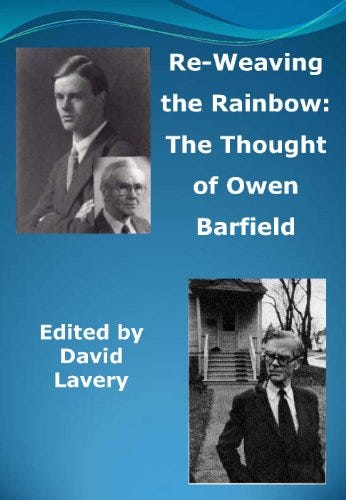
[Owen] Barfield states, all the richness and variety of myth, and all the richness and variety of language, arise from the intermediate stages between consciousness, or mind, and the material world.

George Orwell: Politics and the English Language
What is above all needed is to let the meaning choose the word, and not the other way around. In prose, the worst thing one can do with words is surrender to them. When you think of a concrete object, you think wordlessly, and then, if you want to describe the thing you have been visualising you probably hunt about until you find the exact words that seem to fit it. When you think of something abstract you are more inclined to use words from the start, and unless you make a conscious effort to prevent it, the existing dialect will come rushing in and do the job for you, at the expense of blurring or even changing your meaning. Probably it is better to put off using words as long as possible and get one’s meaning as clear as one can through pictures and sensations
Recorded history is itself a sign of the emergence of a new consciousness, a sign that the timeless consciousness of the magic culture is giving way to a new sense of time and history. Time is beginning to come into human awareness, an emerging sense of temporality, which will lead into new stories of human origins and mythical cosmologies. And with these new myths and cosmologies, there is a new sense of language and words to express them, a new oral tradition that places emphasis on the power of the “vocalized mythical narrative” (“In the beginning there was the Word”). Words take on great significance in the mythical structure as conveyors of psychically rich meaning and vitally infused content.
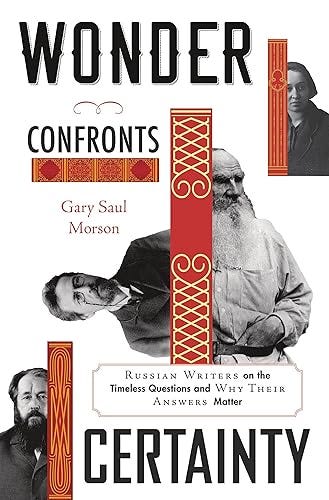
No country has ever valued literature more than Russia. Would any Englishman or Frenchman presume that his people’s existence required vindication? To be sure, other countries (including America) have shared a cultural inferiority complex, but it is hard to imagine an American finding national vindication in a novel. Literature exists to represent life, we naturally think, but Russians often speak as if life existed to provide material for literature: Is that why God created the Russian people?

Drama demands that characters must change, but the audience by and large – ‘we’, let’s be honest – insist they stay exactly the same. Hollywood realized this from the very beginning and set about resolving the contradiction. In the ‘golden age’ of the studio system they created stars who were effectively one character – a Bogart or a Dietrich – and so could appear in a series of different adventures. Then, as the studio system began to fade, sequels came to play a more important role. Ninety-five per cent of them are a disappointment. The notable exceptions – Terminator 2, Aliens, the Toy Storys or The Godfather II – have clear structural reasons why they are as good if not better than their predecessors: either they change the protagonist’s flaw or the nature and scale of the antagonist, or, in the case of The Godfather, continue the tragic journey all the way to spiritual death.
Memoria meant more than recall, more even than actively imagining and engaging with images. It was a place, much as we are using the term in this chapter: a storage place, a chamber, a room, a hall, a warehouse, a cavern. The older term was “thesaurus,” or treasury richly packed with images. Although the entry to these rooms is through the doors of life review, collected there and available to the researching mind are “images that yet / Fresh images beget.”