Quotes: 31 May 2026

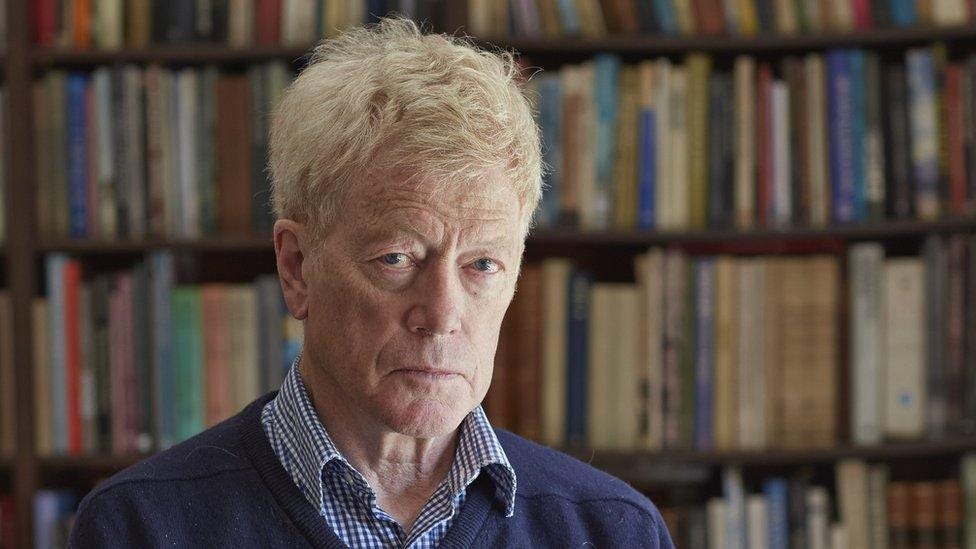
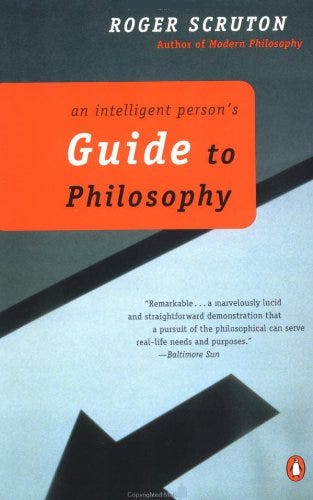
An Intelligent Person’s Guide to Philosophy
A later Kantian philosopher, Wilhelm Dilthey (1833- 1911), extended Schleiermacher’s hermeneutical ‘method’ to the entire human world. We seek to understand human actions, he argued, not by explaining them in terms of external causes, but ‘from within‘, by an act of rational self-projection that Dilthey called Verstehen. In understanding human life and action, we must find the concepts through which the other person perceives and acts upon the world. For example, I understand your fear of speaking in a certain place, once I conceptualize it as you do, as somewhere ‘sacred’. According to Dilthey, our ways of conceptualizing the world in everyday life do not follow the direction laid down by scientific explanation. Rather, they represent the world as ‘ready for action’. I see the world under the aspect of my own freedom, and describe and respond to it accordingly. This before me is not a member of the species Homo sapiens but a person, who looks at me and smiles; that beside her is not a piece of bent organic tissue but a chair on which I may sit; this on the wall is not a collection of tinted chemicals but a picture, in which the face of a saint appears; and so on. In short, we do not merely enter into dialogue with each other; we are in constant dialogue with the world of objects, moulding it through our descriptions so as to align it with our rational purposes. Our categories do not explain the world, so much as endow it with meaning. When I see the Parisian intellectual’s costume as a uniform, I have found its meaning, as an object of human intention and desire.
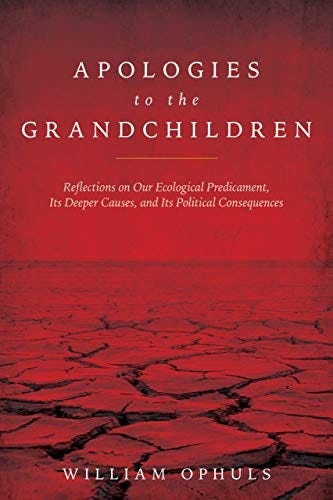
Apologies to the Grandchildren
The solution to the “economic problem” is not economic, it is social and political. Simply continuing to stoke the furnace of human greed is a dead end.

Henry Adams and the Making of America
[Henry] ADAMS HAS TOLD a dramatic story in his nine volumes [History of the United States of America: 1801-1817] —how a nation stagnating at the end of Federalist rule shook itself awake and struck off boldly in new directions in the first sixteen years of the Jeffersonians’ rule. In one way, this picture corresponds with accepted notions. Jefferson had, after all, promised a “second revolution.” But his aim was initially a conservative one—to return to the original Revolution, which had been betrayed by the Federalists. He would draw back from the world, hobble federal power, let states and merchants conduct their own affairs. He promised to be even more wary of foreign entanglements than President Washington had been. He would recall embassies, put the navy to sleep, get rid of all taxes but customs duties, and give himself little to do. Adams agrees that there was, indeed, a second revolution—just not the one Jefferson thought he would be conducting. Yet he gives Jefferson the credit for aspiring to a new revolution, whatever its shape. Jefferson did not betray his principles in riding these new energies. It just proved impossible to return to the days of the first revolution, whether that was conceived in Federalist or Republican terms.
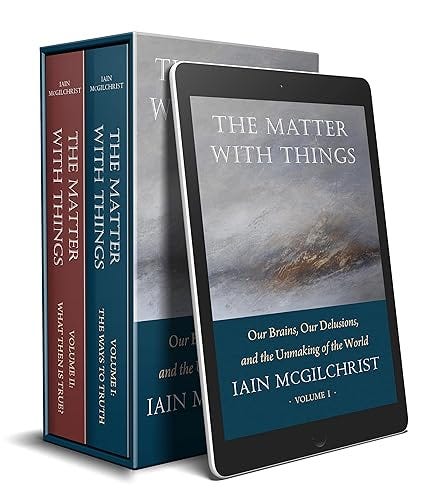
Even if contemporary physics did not demonstrate that this [determinism, reductionism] is an impossibility, there is a problem with this kind of argument. Reductionists and determinists unerringly fail to take account of the fact that their own arguments apply to themselves. If my beliefs are ‘nothing but’ the mechanical products of a blind system, so are all views, including those of the reductionist. If everything is already determined, the determinist’s tendency to embrace determinism is also merely determined, and we have no reason to take it seriously (since we are all determined either to believe it or not already).
. . . .
Truth is emphatically not a free-for-all, a matter of individual whim. Many things – most of the really important things in our lives – can never be proved, but are nonetheless far from being a matter of ‘anything goes’. Here [Paul] Ricoeur comes to mind: If it is true that there is always more than one way of construing a text, it is not true that all interpretations are equal … The text is a limited field of possible constructions. The logic of validation allows us to move between the two limits of dogmatism and scepticism. It is always possible to argue for or against an interpretation, to confront interpretations, to arbitrate between them, and to seek for an agreement, even if this agreement remains beyond our reach.
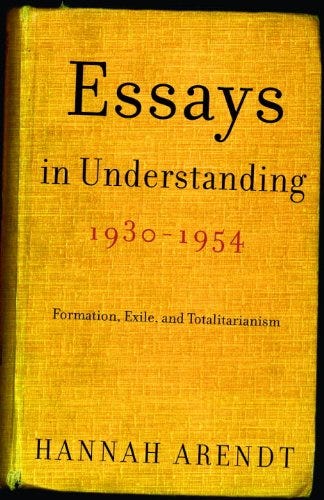
Essays in Understanding, 1930-1954
The so-called chain of happenings—a chain of events is, strictly speaking, a contradiction in terms—is interrupted every minute by the birth of a new human being bringing a new beginning into the world.
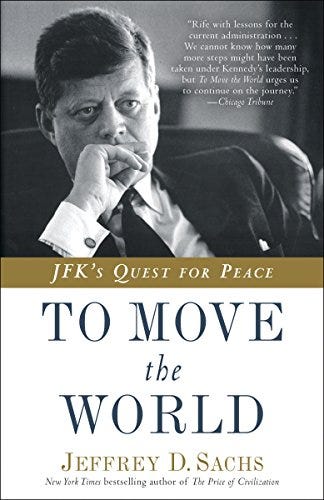
We still threaten ourselves with our own destruction, whether with our armaments or through the world’s remarkable economic productivity coupled with a still-reckless disregard for the natural environment.
Sachs’s book is about JFK and his efforts to maintain peace.
Religion cares nothing for philosophical theism, because religion is not interested in argument. The existence of its God does not require, and does not even admit, proof. For since religion does not define what it means by God, it is impossible to discover what we are to prove. We have to offer our own definition of the term, and whatever definition we offer will necessarily be rejected by religion, because the refusal to admit that God can be defined is vital to the religious consciousness, and to attempt such a definition is already to pass outside the sphere of religion and to falsify, from the religious point of view, our relation to God For the true God, the object of love and worship, we have set up a false God, the object of understanding, and what we prove is always this false God, never the true.
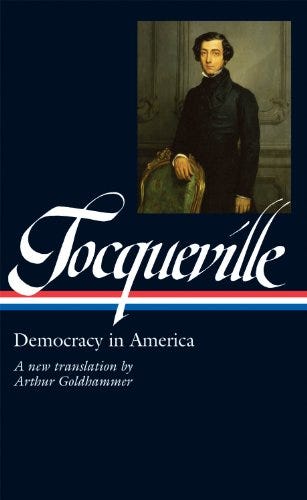
But one also finds in the human heart a depraved taste for equality, which impels the weak to want to bring the strong down to their level, and which reduces men to preferring equality in servitude to inequality in freedom.

Then we can rephrase the constitutive view by saying that language introduces new meanings in our world: the things which surround us become potential bearers of properties; they can have new emotional significance for us, for example as objects of admiration or indignation; our links with others can count for us in new ways, as lovers, spouses, or fellow citizens; and they can have strong value.