Quotes: 29 July 2026
Rhetoric, Persuasion, & Power

Whatever the method—logical, empirical, phenomenological—we have to use language. A method persuades us by the power of its language, its rhetoric, defined as “the art of persuasion.” Therefore, if we can get at the ideas embedded in the language about power, unpack the persuasive ideas that affect our thought and behavior, we shall be as close as we can get to knowing the components of power. All day long, terms like “control,” “prestige,” “ambition,” “charisma,” “authority” cross our lips without much thought and enter into judgments that determine our decisions, and our relations with colleagues.
Rhetoric is about the best ways of getting and holding attention with language, and shaping that attention to achieve particular outcomes.
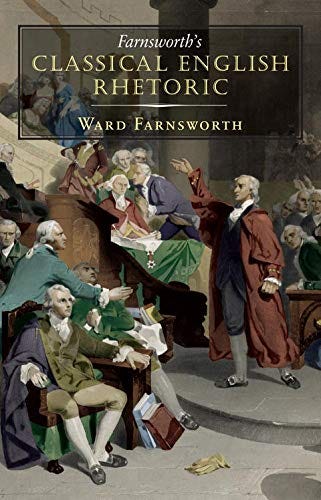
Farnsworth’s Classical English Rhetoric
Rhetoric is a vast, old, and honorable discipline. It may be defined most broadly and simply as the use of language to persuade or otherwise affect an audience.
Communications that persuade through ethos are those perceived to be the most sincere or pure, or those coming from a wise source that is “without guile.” Pathos is the method that stirs the emotions of the audience, moving them through appeals to their passions or fears. Communications that persuade through pathos are those that fire up the audience or inspire them to act by appealing to their deepest loyalties. And, finally, logos refers to the actual message of the communication, which usually takes the form of a good argument or a compelling reason that has the power to convince or otherwise entice the audience into agreement.
. . . .
Comparing Aristotle’s three modes of persuasion with the premises of the evolutionary method, we can detect the influence of goodness, beauty, and truth on his overall categorical scheme. Specifically, ethos is most closely connected to the virtue or goodness of the speaker; pathos employs style or beauty to move the audience; and logos is about the actual message content or truth of the communication itself.
While it is true that Aristotle presents rhetoric as primarily an art of persuasion—an argument “is persuasive (pithanon) because there is someone whom it persuades”—the whole tenor of the book is to distinguish sharply between arguments that ought to persuade (studied by dialectic) and sophisms (studied by rhetoric strictly so called).
In the “good” Aristotle, you’ve got your ethos—the credibility, character, or status of the speaker; your pathos—the reader or listener’s emotional condition; and your logos—the linguistic and logical properties of the argument itself. Aristotle’s three principles are often applied in later careers within various spheres, realms of life that Aristotle also instructively lays out. They are the “deliberative,” which Aristotle defines as a political speech before a parliamentary assembly, but which applies to any address made to a group—an academic committee meeting, the board of one organization of another, the local PTA. The “judicial” is a court of law. The “epideictic,” a ceremonial speech, seems particularly relevant to our otherwise unceremonial time. It levels blame or confers praise, using as its central means of persuasion a characterization of its target’s behavior as dishonorable or shameful.
Aristotle identified three different lines of argument, or persuasive appeal, into which the process of invention divides. Thanks to my constitutional childishness, they have always sounded to me like the names by which the Three Musketeers really should have been known: Ethos, Logos, and Pathos.
[The] key term for the old rhetoric was “persuasion” and its stress was upon deliberate design’, [Kenneth Burke] wrote. ‘The key term for the “new” rhetoric would be “identification,” which can include a partially “unconscious” factor in appeal.’
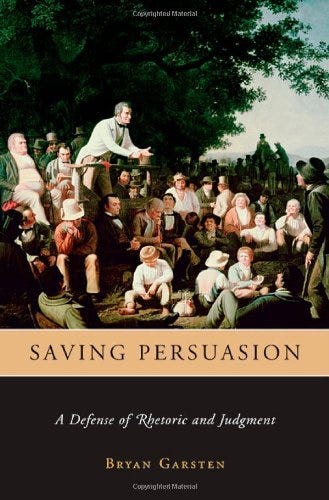
Political theorists tend to focus on reasonable dialogues of justification rather than passionate exchanges of rhetoric. While actual politicians have not abandoned persuasion (how could they?), they prefer not to acknowledge their art. They understand that when they hear an argument described as “described as “rhetorical,” it is being either decried as manipulative or dismissed as superficial. In both theory and practice today, the reigning view of rhetorical speech is that it is a disruptive force in politics and a threat to democratic deliberation.
This book aims to challenge that conventional wisdom. Its guiding motivation is the thought that a politics of persuasion-in which people try to change one another’s minds by appealing not only to reason but also to passions and sometimes even to prejudices-is a mode of politics that is worth defending. Persuasion is worthwhile because it requires us to pay attention to our fellow citizens and to display a certain respect for their points of view and their judgments. The effort to persuade requires us to engage with others wherever they stand and to begin our argument there, as opposed to simply asserting that they would adopt our opinion if they were more reasonable.