Quotes: 21 June 2026
Happy Summer Solstice to all who celebrate!

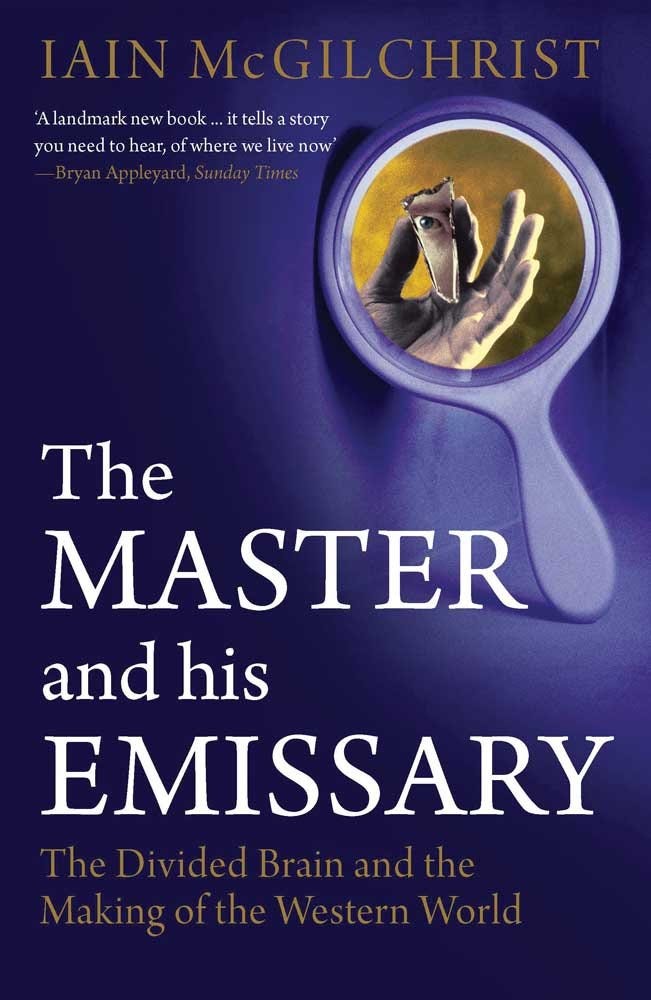
There is an optimal degree of separation between our selves and the world we perceive, if we are to understand it, much as there is between the reader’s eye and the page: too much and we cannot make out what is written, but, equally, too little and we cannot read the letters at all. This ‘necessary distance’, as we might call it (it turns out to be crucial to the story unfolding in this book), is not the same as detachment. Distance can yield detachment, as when we coldly calculate how to outwit our opponent, by imagining what he believes will be our next move. It enables us to exploit and use. But what is less often remarked is that, in total contrast, it also has the opposite effect. By standing back from the animal immediacy of our experience we are able to be more empathic with others, who we come to see, for the first time, as beings like ourselves.
The frontal lobes not only teach us to betray, but to trust. Through them we learn to take another’s perspective and to control our own immediate needs and desires. If this necessary distance is midwife to the world of Machiavelli, it also delivers the world of Erasmus. The evolution of the frontal lobes prepares us at the same time to be exploiters of the world and of one another, and to be citizens one with another and guardians of the world. If it has made us the most powerful and destructive of animals, it has also turned us, famously, into the ‘social animal’, and into an animal with a spiritual dimension.
As he watched the eyeless face with the jaw moving rapidly up and down, Winston had a curious feeling that this was not a real human being but some kind of dummy. It was not the man’s brain that was speaking; it was his larynx. The stuff that was coming out of him consisted of words, but it was not speech in the true sense: it was a noise uttered in unconsciousness, like the quacking of a duck.
Reminds me of someone we all know of.
The Greatest Sentence Ever Written
Alexis de Tocqueville, who wins the award for being the least read but most quoted author about America, made an assertion that I think is wrong. He argued that there was an inherent struggle in America between two opposing impulses: the spirit of rugged individualism versus the conflicting spirit of creating associations and common grounds. But, in fact, the two strands are woven together, the warp and woof of the American fabric.
When I speak of action, I shall be referring to that kind of action in which the agent does what he does not because he is in a certain situation, but because he knows or believes himself to be in a certain situation.
The self isn’t defined as a thing or a personal essence, but rather in terms of self-awareness, the experience of being a subject and an agent. To put the idea another way, phenomenologists maintain that the self is a structure of experience, the structure whereby one experiences oneself as oneself
As Kathleen Raine put it: ‘the imagination does not see different things, it sees things differently.’
Patrick Ophuls, forward by Jack Kornfield
Alas, we live in a degenerate age dominated by the forces of greed, hatred, and delusion. Hence the spiritual principle is in partial eclipse. If we’re going to get to nirvana, it will be under our own steam—and on the milk train.
Defenses Against the Dark Arts
In the Fudge regime, these fountain figures are specist, sexist, self-congratulatory propaganda pieces for mage (and wizard) superiority in magical Britain. Dumbledore’s animation turns them into self-sacrificing heroes, which is what a virtuous republic would want them to be. But already Harry is seeing that public monuments and other memorials are ventures in political mythmaking. (Remember nationalists who sometimes fabricate relics?) Seldom are public commemorations simply good or bad as art, right or wrong as history, uniting or dividing as politics. In general, they can be true and false, constructive and destructive, loved and reviled, depending on perspectives.
Worth noting in our time of celebrations and commemorations of the 250th anniversary of our nation’s independence, and the new monuments to our Dear Leader. N.B. I contend that our nation wasn’t fully created until the adoption of the Constitution.
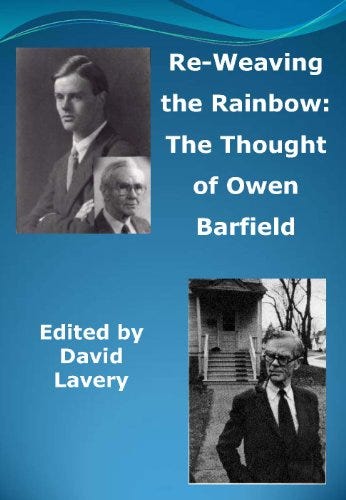
While [C.S.] Lewis thought revelation happened once and for all, Barfield, as we know, believed in the ongoing process of the evolution of consciousness—therefore of revelation.
A more inspired notion of influence comes from Henry Adams (1838–1918), the distinguished American elder who said that “susceptibility to the highest forces is the highest genius.” Here, the power of influence turns altogether away from my effect on you or yours on me. Here, influence means suggestibility, the capacity to receive these “highest forces.” But what and who are they? Members of the board, senators, lobbyists with caches of cash? Or are they perhaps the writings of ancient philosophers and the visitations of informative dreams?
To be open to influence of the sort Adams recommends requires, first, to be clear about what you consider to be “the highest forces” and, second, to refine your susceptibility so that you can filter all the information coming in. The old theologians called this filtering diakrisis, discerning the spirits. Without discernment, they thought you could become a dupe of the devil. Discernment allows you to be more sophisticated about the forces, hearing them metaphorically and not only literally, so that you do not become a mouthpiece of your mentor or a channel of visionary wisdom masking as genius.