Quotes: 2 August 2026
Choice cuts

Apologies to the Grandchildren
And it is indeed up to you [the “grandchildren”]; your elders are probably irredeemable. While we may have left you with little in the way of resources, your task is not hopeless. In the end civilization is not something material, it is spiritual. Be inspired by the beauty of the cosmos to invent a way of being devoted to feeding the soul instead of filling the belly. Rediscover the spiritual abundance that resides in material simplicity. Learn again that the only wealth worth having lies in the treasury of the human heart.
. . . .
That industrial civilization is being strangled by a slowly tightening noose of ecological scarcity has been apparent to anyone who cares to examine the evidence without prejudice. Sadly, this patent reality continues to be mostly denied in societies made up largely of the passively uninformed and the passionately misinformed.
As an elder, I refuse to concede that we should leave this mess unaddressed for the next generation to fix, even though the elder-in-chief and his ilk would have us do so.
Writing During the Apocalypse
Ed Simon
We can remember stark changes and dark omens within our own lifetimes, with Brady and Isen noting that we are in a “time when the majority of us can still remember when things were more stable … We are forced to confront, in strange and sometimes painful ways, how much those places have changed.”
Who is young enough today not to know how the world has changed? In my seven decades, these changes are patent and disturbing. How do fools delude themselves that everything is hunky-dory?
What really struck me most in the article was its novel argument that WITs [Worldviews, Institutions, & Technologies] are the primary “unit of selection” in the evolution of our societies. In other words, by carrying a society’s information and structure through time, a dominant WIT plays a role in society analogous to a gene in a biological system. Whether the WIT survives or is replaced by a less dominant WIT depends on the “fitness” it confers to its social system— that is, on the extent to which it helps that system reproduce itself in its larger environment.
Our current dominant WITs are serving us poorly and threatening our continued well-being, to put it mildly.

The Jewish middleman minority was seen by many in the local elite as a mass of hostile Bolshevik sympathizers. The Jews, to them, represented the evils of capitalism and Communism at the same time. This was during a period when Romania was in the course of losing the historic territories of northern Bukovina and Bessarabia to Soviet Russia.
A terrific book about Romania, a fascinating nation. (We lived there for about two years.)

The idea of the League of Nations as an “eminently practical scheme” runs counter to the mythologies that have grown up around Wilson and the League over the past century. Yet a good number of Americans in Wilson’s day had latched on to the idea of a league as the best solution to a complex problem: how to bring American power to bear for the preservation of peace in the present without making ironclad commitments to go to war in the future. Long before Wilson came to embrace the idea, it was the Republican statesmen—Taft, Lodge, and Roosevelt—who were the League’s first and most enthusiastic spokesmen.
Sometimes political positions are taken—and changed—for the most personal and unprincipled reasons. Et tu, Teddy!

The Secret Teachers of the Western World
The central reason this [revelatory, speculative, or metaphysical] knowledge is rejected is that it fails to meet the criteria of “real” knowledge set by modern science. Since its beginnings in the seventeenth century, modern science has focused on the kind of “facts” that can be grasped by the senses and proven by measurement. It abandoned the religious explanations for the world, which posited an unseen God behind the universe; accepted only that which it could see and touch; and brought an acute analysis to the phenomena of the physical world. Gradually, and with increasing certainty, it came to the conclusion that the only knowledge worth knowing was the kind that could be quantified. Physical laws that could be observed and measured would, it believed, account for everything, and the belief that anything else was needed or that anything could escape the necessities imposed by these laws was abandoned.
Speech is an expression of man giving shape and order to the world, something, [Ernst] Cassirer suggests, that also comes through in art. ‘Like all the other symbolic forms,’ Cassirer writes, ‘art is not the mere reproduction of a ready-made, given reality. It is one of the ways leading to an objective view of things and of human life. It is not an imitation but a discovery of reality’.
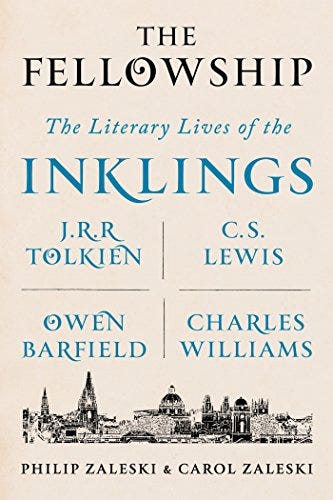
Philip Zaleski and Carol Zaleski
In Characteristics of Men, Manners, Opinions, Times (1711), the third Earl of Shaftesbury described the poet as “a second Maker, a just Prometheus under Jove”: this definition would circulate widely among the Romantics. Coleridge advanced the metaphor by positing a primary and secondary imagination—a terminology that surely influenced Tolkien’s account. The primary imagination, argued Coleridge, is the power of the mind to perceive, regulate, and give form to the inchoate raw data of perception, just as God brings order out of chaos: “the living Power and prime Agent of all human Perception … a repetition in the finite mind of the eternal act of creation in the infinite I AM”; the secondary imagination takes the world perceived and shaped by the primary imagination, scatters it, and reassembles it as art: “The secondary Imagination I consider as an echo of the former, co-existing with the conscious will … it dissolves, diffuses, dissipates, in order to re-create.”

Whatever the placebo effect actually is, the medical community agrees that its results are subjective. And while that subjectivity is often cast as its most critical weakness, there’s a case to be made that subjectivity is also its greatest strength.