Quotes: 14 May 2026
Variety pack

The promise of expertise, first made in the seventeenth century, is to provide us with a version of reality that we can all agree on. The promise of digital computing, by contrast, is to maximize sensitivity to a changing environment. Timing becomes everything. Experts produce facts; Google and Twitter offer trends. As the objective view of the world recedes, it is replaced by intuition as to which way things are heading now. [Emphasis original.]
I.e., vibes.
. . . .
[T]he speed and immediacy of smell makes it an indispensable means of recognizing individual places, foods, and possessions, with a level of certainty that cannot be converted into an objective fact.

Collingwood speaks of bringing the passions under control, of (with Spinoza) turning passio into actio, of a passion understood as a passion dispelled. Here, more winningly and as it seems to me more accurately, the emotions give thought its form. The larger and more comprehensive they are, the better chosen the distance from which they do their work, the truer and more permanent the thought.
Continuity, like extension in space or time, cannot be put together, only taken apart.

The [Chinese CCP] government was offering its people a bargain: prosperity in exchange for loyalty.
As we add billions more people to the world’s population, and as these people—quite reasonably—strive for a higher standard of living that includes a protein-rich diet, the global output of synthetic nitrogen will far surpass today’s already huge output.
Note that the fertilizer supplies have reduced due to Trump’s & Netenyahu’s War on Iran and the resulting closure of the Strait of Hormuz, which has resulted in higher prices and reduced supplies of fertilizer.

The actions and words of ritual frequently have an iconic or symbolic relation to what they are trying to effect, or to the order they are meant to repair, but the crucial point about them is that they are performatives, they help to bring about what they (at least in part) represent.
As Wilson writes, “High development of the instinctive levels is incompatible with the kind of concentration upon detail needed by civilized man.”
“Historical research sticks to the antecedents of a singular fact, sociological research to the causes of a fact which may be repeated”
. . . .
The historian “thinks away” the suggested cause “in order to judge what difference its nonoccurrence would have made in the light of what else he knows about the situation studied”
Essays in Understanding, 1930-1954
Communal human life, that is, the historical world, is so much a condition of being oneself that “authentic Being-one’s-Self does not rest upon an exceptional condition of the subject, a condition that has been detached from the ‘they’; it is, rather, an existentiell modification of the ‘they’—of the ‘they’ as an essential existentiale.”
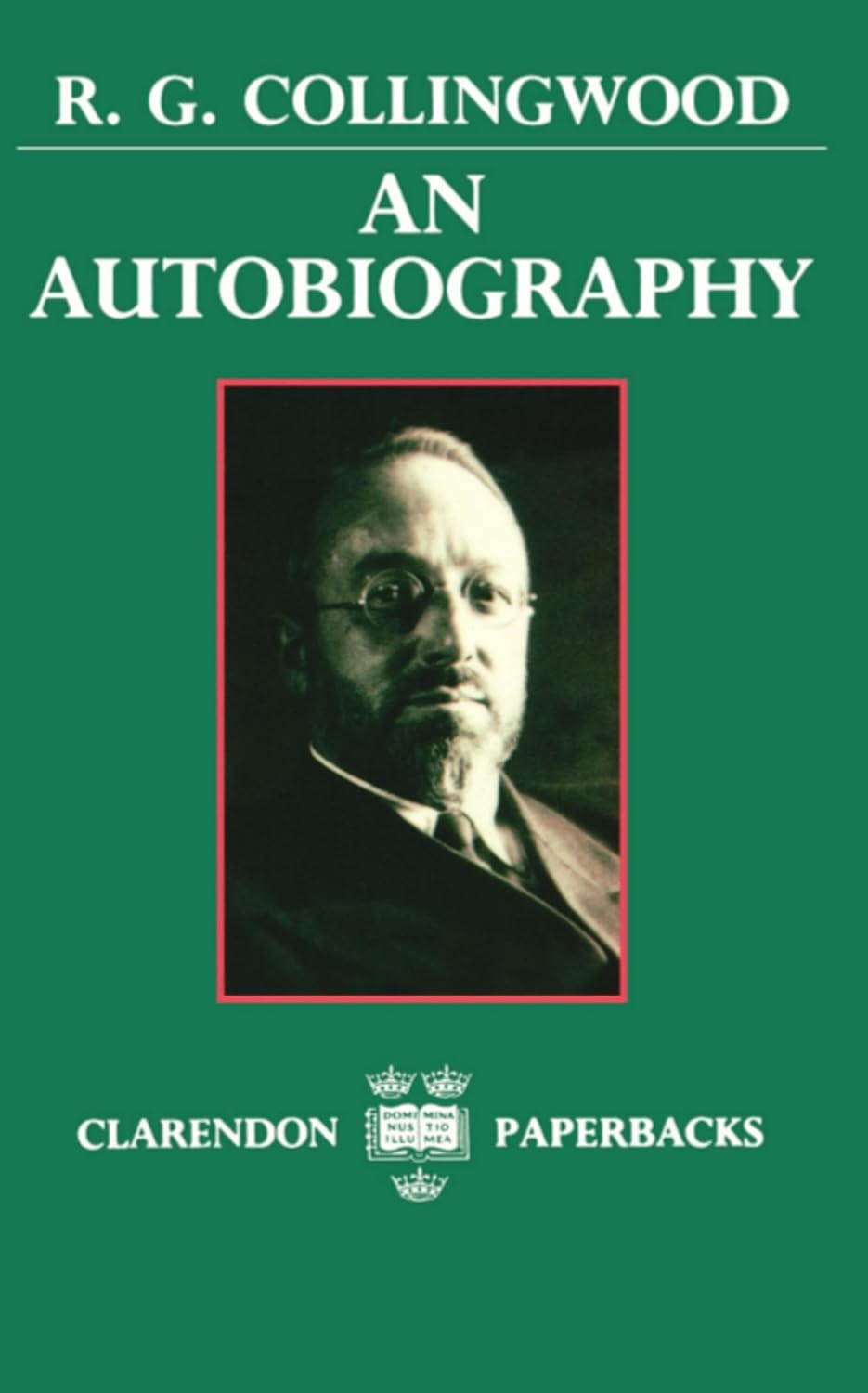
My work in archaeology, as I have said, impressed upon me the importance of the ‘questioning activity’ in knowledge: and this made it impossible for me to rest contented with the intuitionist theory of knowledge favoured by the ‘realists’. The effect of this on my logic was to bring about in my mind a revolt against the current logical theories of the time, a good deal like that revolt against the scholastic logic which was produced in the minds of Bacon and Descartes by reflection on the experience of scientific research, as that was taking new shape in the late sixteenth and early seventeenth centuries. The Novum Organum and the Discours de la Méthode began to have a new significance for me. They were the classical expressions of a principle in logic which I found it necessary to restate: the principle that a body of knowledge consists not of ‘propositions’, ‘statements’, ‘judgements’, or whatever name logicians use in order to designate assertive acts of thought (or what in those acts is asserted: for ‘knowledge’ means both the activity of knowing and what is known), but of these together with the questions they are meant to answer; and that a logic in which the answers are attended to and the questions neglected is a false logic.
. . . .
I began by observing that you cannot find out what a man means by simply studying his spoken or written statements, even though he has spoken or written with perfect command of language and perfectly truthful intention. In order to find out his meaning you must also know what the question was (a question in his own mind, and presumed by him to be in yours) to which the thing he has said or written was meant as an answer.