Inventing America: Jefferson's Declaration of Independence by Garry Wills
A gift from my wife in 1978

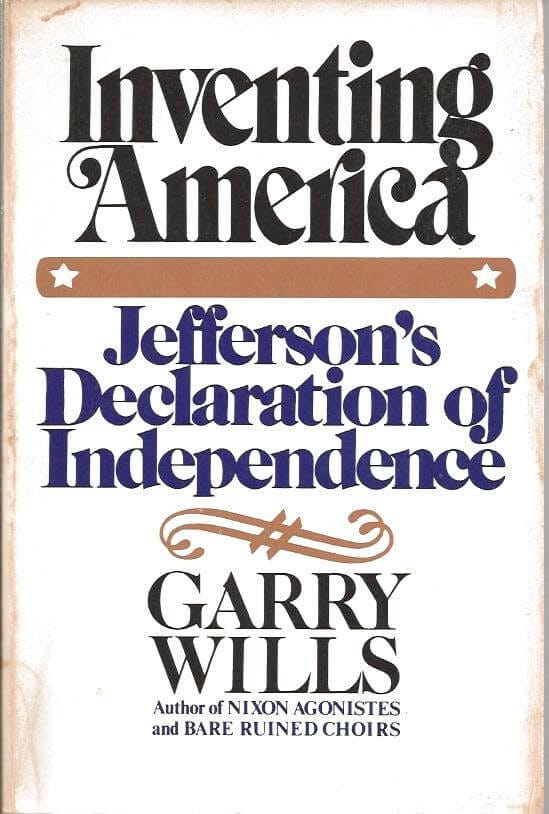
In case you hadn’t heard, or perhaps you're trying to ignore the fact, given the current president, but this year marks the 250th anniversary of the American colonies declaring independence from Great Britain. As it’s my custom to read a work of American history to celebrate the Fourth each year, for this particular anniversary, I’m going all in. I plan to read extensively about the founding of our nation and that era’s most significant documents, including The Declaration of Independence, the Constitution, The Federalist Papers, and others. The book above is a part of this project. And reading this book—again—was a treat.
I received Inventing America from my wife in August 1978, near the start of my third year of law school. I’d become a big fan of Wills in the summer of 1976, when I read both Nixon Agonistes: The Crisis of the Self-Made Man (1970) and Bare Ruined Choirs: Doubt, Prophecy, and Radical Religion (1972). Wills was described somewhere as a journalist trained as a classicist (or was it vice versa?). At any rate, from the first two books of his that I’d read, I’d learned that he combined rigorous analysis with a keen eye for detail, all delivered in exceptionally engaging prose. So what would he do with a book about “Jefferson’s Declaration of Independence”? More of the same.
The focus of this book is on Jefferson’s original draft as a reflection of Jefferson’s thought. In taking this path, Wills upends a tradition of Jefferson scholarship that pegs Jefferson’s work as a direct descendant of John Locke’s liberal individualism, such as argued in the the most widely regarded work on the Declaration up to that time: Carl Becker’s The Declaration of Independence: A Study in the History of Political Ideas (1922), which portrayed Jefferson’s thought as arising from Locke, Rousseau, and the Englightenment natural rights tradition. Wills, through intellectual detective work, argues that the primary influence on Jefferson’s political thought comes from the Scottish Enlightenment, which includes Francis Hutcheson, David Hume, and Lord Kames primarily, with the works of Adam Smith (Theory of the Moral Sentiments), Thomas Reid, and Adam Ferguson likely to have been influential as well. The Scottish tradition—much more dynamic and influential than anything coming out of Oxford or Cambridge at that time (Wills describes these institutions as “sonambulent”)—was a core part of Jefferson’s education at William and Mary College and beyond. The tradition emphasized “benevolence,” “affection,” “society,” “moral sense or taste,” “sympathy,” and “common sense.”
Wills’s argument doesn’t deny that Locke’s thought was also influenced Jefferson, as well as that of some figures from the French Enlightenment. Jefferson was a wide-ranging reader and experienced practitioner in politics, and his works reflect a broad range of influences. But after Wills published this book, no one could credibly argue that Jefferson’s thought was simply “Locke for Americans.”
I should also note that while the most important aspect of this book is the intellectual detective work that Wills performs for his readers, we also enjoy his descriptions of the men involved in the politics of the adoption of the Declaration, told with the eye of a seasoned political reporter. Before Wills begins his tale of detection, he sets the scene.
All in all, this is a superb book, one that I’ve enjoyed immensely again nearly 50 years on. Can there be a higher compliment?